George Whittle
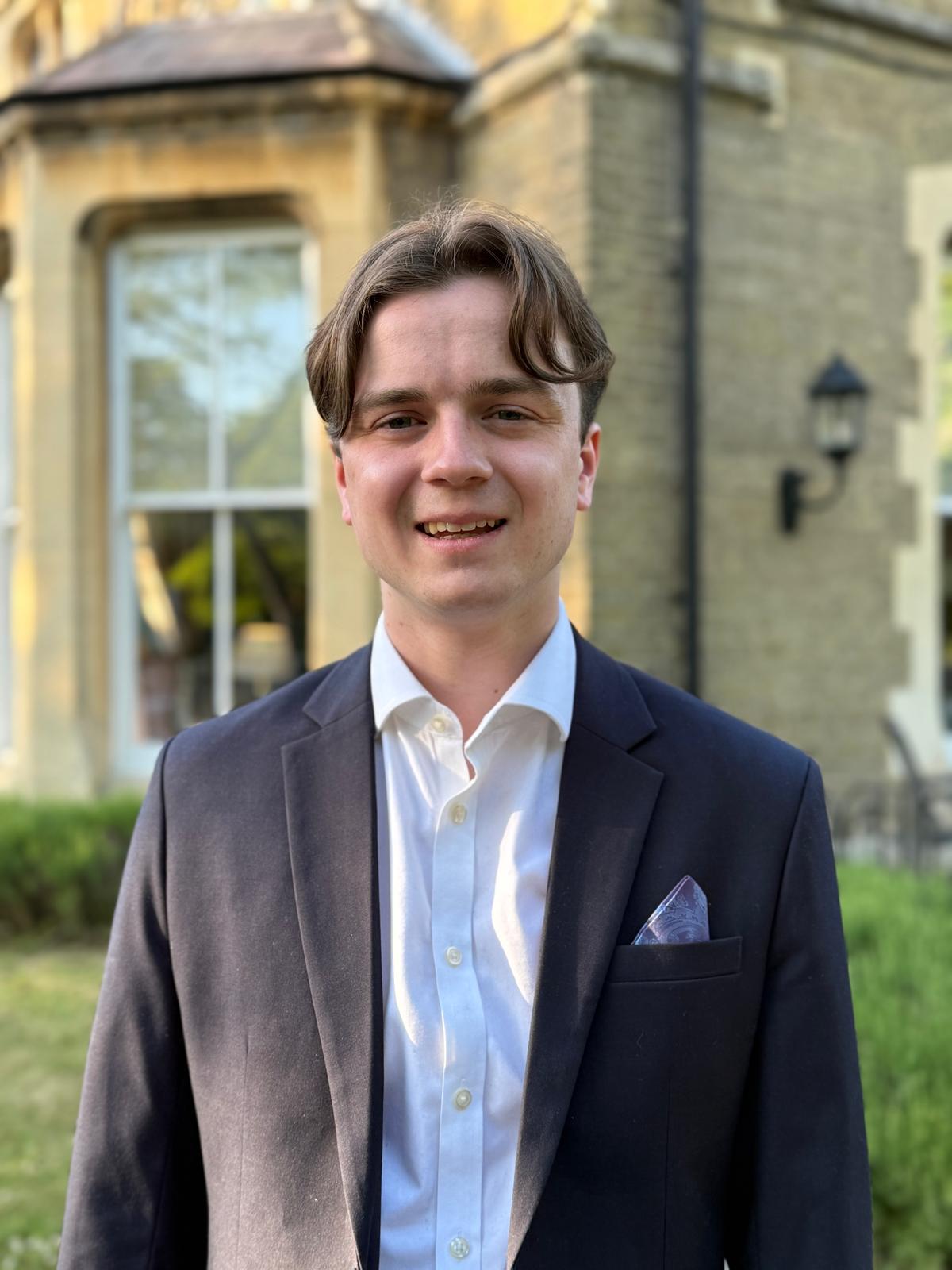
I am a PhD student at the University of Oxford working on the theory of deep learning and its application to real-world inference and control. My research is split between the Machine Learning Research Group (supervised by Professor Maike A. Osborne) and the Quantum Device Lab (supervised by Professor Natalia Ares).
My research interests lie in
- Neural Network Theory
- Amortised Bayesian Inference
- Quantum Device Control
More specifically, the unifying thread of my theoretical work is wide, overparametrised neural networks — those with many more parameters than training examples. I study both the lazy-training regime, where the Neural Tangent Kernel renders networks analytically tractable, and the feature-learning regime, where I use the Maximal Update Parametrisation (μP) to build new theory of how wide networks learn representations. Throughout, my goal is to advance our understanding of deep learning through a Bayesian lens.
Alongside my academic work, I have industry experience in quantitative finance, with quant research internships at Point72 and Gresham Quant — building systematic statistical-arbitrage signals and liquidity-aware portfolio optimisation — and I collaborate part-time with Mind Foundry on Bayesian filtering for defence applications. My CV gives a fuller account.
Before my PhD, I completed the MEng Engineering Science course at Oxford, placing 3rd of 141 students overall (2nd of 176 in the first public examinations, and 1st in the Master’s-year module Robust Optimisation and Control Theory). My Master’s thesis, LLM-Enhanced Bayesian Quadrature for Neural Ensemble Search, was also supervised by Professor Maike A. Osborne. Earlier, I researched AI for Early Classification of Cardiovascular Conditions with Professors Alison Noble, Jens Rittscher, Vicente Grau, and Konstantinos Kamnitsas, and Neural Kalman Filters with Professor Konstantinos Gatsis.
If you’d like to chat, feel free to reach out via george.whittle@reuben.ox.ac.uk
News
| May 15, 2026 | New preprint online: Canonical Regularisation of Wide Feature-Learning Neural Networks. |
|---|---|
| May 1, 2026 | Two papers accepted as spotlights at ICML 2026: Distribution Transformers and Recurrent Structural Policy Gradient for Partially Observable Mean Field Games. |
| Jan 21, 2026 | Bayesian Fourier Features for Reduced Rank Gaussian Processes was accepted at AISTATS 2026. |
| Sep 25, 2025 | Just One Layer Norm Guarantees Stable Extrapolation was accepted at NeurIPS 2025. |
Selected Publications
2026
-
In The Forty-third International Conference on Machine Learning (spotlight), 2026
2025
-
In The Thirty-ninth Annual Conference on Neural Information Processing Systems, 2025